

Where do you get inspiration for the garden?
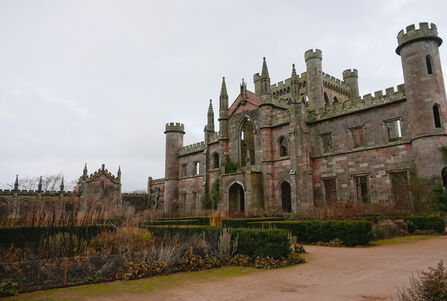
Lowther Castle is a development project. The garden had been lost to time; for the past 70 years, it had been used for farming and forestry. Now, we’re rediscovering the Edwardian character, and we’re working with landscape designer Dan Pearson to help us capture the spirit of the place with a modern outlook. We are staying on the wild side with a very sympathetic planting palette but also aiming to push boundaries by growing unusual plants that still complement the setting.
I believe our inspiration comes from nature, with an appreciation for horticulture and design expressed subtly. We have a framework to create a visitor attraction that inspires people to visit us annually, and maybe even take something home.
Which flowers do you like best in the garden?
I enjoy early June when cow parsley erupts along the country lanes. It's lovely that we’ve begun establishing patches in the garden. I like it when our terrestrial orchids bloom. I also adore our Tapestry Parterre, mainly planted with North American prairie plants. Having spent some time in North America, it's nice to work with this familiar plant palette.
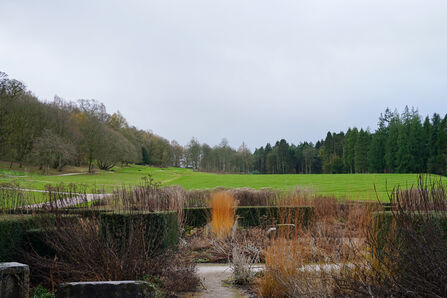
There’s a planting of joe pye weed, eupatorium, which looks truly glorious throughout autumn, and even now in winter, it stands tall with its seed heads and looks fantastic – it’s also a good food source. Because I’ve always gardened in the South of England, I had to adapt to Cumbria and its wet climate. There are some grasses I really like; the molinia do well here, and at the moment, they look very striking, just these blonde streaks through the border, which are quite stunning and add interest.
I would also suggest that we are a generation of gardeners now, and we should work with nature because you’re never going to win against it.Lowther Castle
What tips do you have for other gardeners?
I tell myself, patience; one can’t do it all in a season. We are working on 130 acres, and the team is relatively small, so it will take us, like planting the meadow with daffodils, a couple of years before we reach the end. We’ve just started another project to underplant the rose garden beds with minor spring bulbs to attract early pollinators and add some diversity to a monoculture of roses. Again, just thinking about it, it will probably take four or five years before we’ve planted it all.
Another is observation: just always thinking about what you’re observing and taking a record of it, as it helps build a mental library.
I would also suggest that we are a generation of gardeners now, and we should work with nature because you’re never going to win against it. So, accept certain things, maybe certain weeds and integrate them into our schemes. So: observation, patience and acceptance.
Which is your favourite part of the garden?
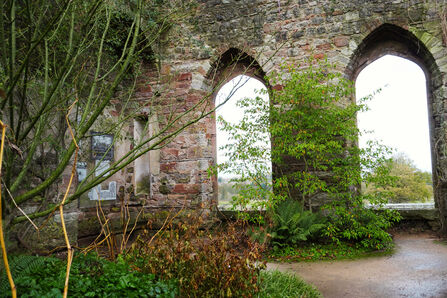
It depends on the time of year. I think that in spring, the Garden of the Ruin itself is spectacular; it bursts into life within a very contained space. Since I love perennials, the Tapestry Parterre in front of the castle is quite loose and wild, and I like that a lot. As for the meadows, we’ve been doing a lot of work there, and I find it rewarding as we begin to see the improvements. Over the last few years, we’ve started to introduce a few new species; we’ve got meadowsweet in there now. We had orchids, and the population has doubled. We planted great masterwort, astrantia, which is a European native; it looks great in the long grass – these silver stars that sweep through the meadow.
In the rush meadows, we’re reintroducing species to improve their ornamental value, but in our wildflower meadows, we stay relatively pure; we use British natives. It all fulfils an ecological function as a diverse habitat, and it demonstrates how we manage the space with limited manpower.
We leave all our seed head structures in the Tapestry Parterre, and when we take them down at the end of February, we chop and drop them, then leave them in place; we don’t compost them elsewhere.Lowther Castle
What wildlife do you get currently?
We have a heronry; it was a former Iris Garden. It’s a bit like Heathrow Airport in the spring. I think we have 17 nests; it’s like Game of Thrones when the Heron swoops down and lands in the Rose Garden. We have a good, healthy red squirrel population. We work very closely with the Penrith squirrel ranger. We started recording our bird observations; we have little wrens and goldcrests, and we have a local buzzard who sits on the Castle ruin. My colleague did tell me that the buzzard substituted its diet with worms, I didn’t know they did.
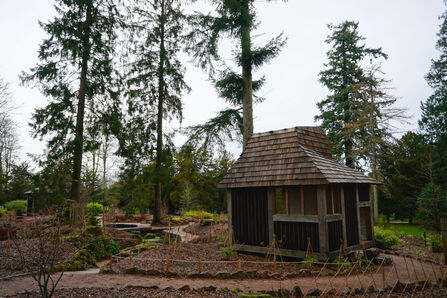
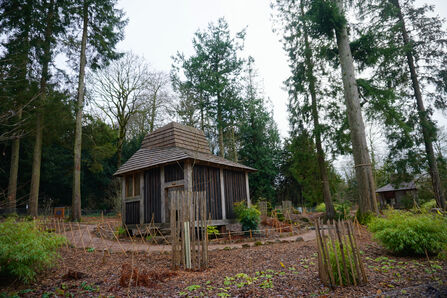
We also have a barn owl, so when you come early, you sometimes see them sweeping overhead. I would like to see more foxes, as we have quite a high rabbit population. We have hares passing through and a healthy badger population. There is a sett that’s believed to be over 50 years old in one of the banks, and I love seeing their tracks. They started making auxiliary burrows, and the story goes that when it gets a bit too rowdy in the summer, the male might leave for a while to have some quiet time. One has moved into the Rock Garden, which presents a bit of a challenge in developing that area, but we’re planning to create more shrubbery around this ‘summer house’.
Last summer was a bit sad in terms of butterflies, as we didn’t observe any. We had such a wet and cold spring. But this year was the complete opposite; I observed loads of them, such as the red admiral. We have a lot of hoverflies, which are understated pollinators. Next year, we’re hoping to do some surveying to understand what we have, since it’s mainly anecdotal for now.
This summer, we experienced a notable interaction: ground-nesting wasps were found in the rose garden near the Rose Garden entrances. Then, a few days later, the badger appeared and ate them all.
We have bats in the Castle ruin, and we started in the summer with a device to attract the swifts to the ruin.
How do you attract/look after the wildlife?
Our meadows, for instance, stay up quite late. We leave all our seed head structures in the Tapestry Parterre, and when we take them down at the end of February, we chop and drop them, then leave them in place; we don’t compost them elsewhere. Last year, a section of the border had to be taken down early because we planted tulips, so we gathered all the clippings and used them to build structures.
Then we have the Rush Meadows, where we aim to introduce more decorative elements. We were cutting them late in September and gathering the long grass to make haystacks to leave out until spring. When we remove them, we are left with a bare patch of soil that we can plant into. In the meantime, it serves as a shelter and also adds an extra pattern to the meadow.
Regarding deadwood, we only remove it if it obstructs and then place it into wilder areas.
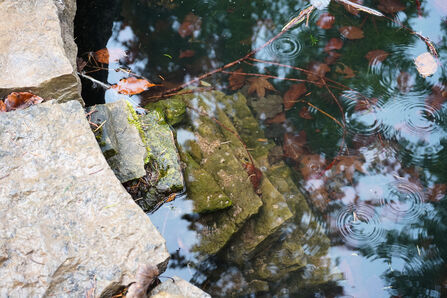
We have newts in the Rose Garden pond, so we installed newt ladders to help them reach land. We repaired two other ponds and insisted, ‘let’s just put a newt ladder in’, so the newts could move into them as well. And on the note of ponds, we also have a thriving population of dragonflies.
We also have three wild bee boxes, one in the Orchard, one in the Woodland and one in the Sweet-Scented Garden.
We work hard to minimise our use of pesticides. The only time we apply herbicide is when creating a new area of garden, and that would be the only application, followed by covering the entire area with 15cm of woodchip to help suppress the emergence of the seed bank.
We are also working on having food sources for pollinators as early as possible in the year. It’s always amazing to see the early bees on snowdrops, which is like ‘what are you doing out already?’ but anyway, they’re out! So, starting with the snowdrops, followed by daffodils and willows, and in the Rush Meadows, we are providing more food now by introducing flowering plants.
In the meadows, we started to create a more cohesive mosaic. A colleague of mine in the South has begun to cut in squares at random times of year, which creates different heights, ergo habitats. Nature conservation has moved from creating mosaics to kaleidoscopes with movement and other patterns to attract as much wildlife as possible.
We ask our visitors to join us on this journey and to accept that it's okay to chop and drop your perennial in situ at the end of winter.Lowther Castle
What steps do you take to keep it tidy whilst being wildlife-friendly?
We have a lot of long grass areas, so we make them more attractive by cutting neat verges, which shows that we are looking after these areas too.
We do try to keep the edges of our borders tidy. To control weeds along path edges, we use a weed burner. We ask our visitors to join us on this journey and to accept that it's okay to chop and drop your perennial in situ at the end of winter. In my first year at Lowther, I was a bit nervous, so I covered the clippings with leaf mould, but I think one should just be able to talk about it and say ‘this is what we’re doing’.
Fortunately, Lowther Castle & Gardens is a relatively young garden, so we have the chance to avoid falling into those Victorian horticultural traps of everything being neat and prim. That’s also what I appreciate about working here: we can garden in a more nature-friendly way because ‘tidy’ really means fighting nature 24 hours a day, seven days a week, and you’re never going to win that battle.
What are your future plans for helping wildlife?
I don’t know if it’s going to help wildlife directly, but I’m really excited that we’ve got someone now looking at ecology and recording how our way of gardening has improved things and will improve things for wildlife. The other thing I’m excited about is more people engagement and being able to talk to the public about what we are doing, to inspire them at home, and hopefully that will go beyond ‘no mow May’.
Then, also thinking about public events, we could have a bird survey, inviting the public to help us with it, and we’re hoping to do an event about the hay meadows. We do have an excellent mycorrhizal level in the ground, so hopefully we can host an event about fungi in the autumn. We want to start monitoring the spread of our terrestrial orchids, so we’re focusing more on reporting and continuing our work. As I mentioned, I’d like to start cutting the meadows at different times to mimic herbivores coming through, to see if we can create a more tapestry.
We have some meadows dominated by knapweed because of our rich soil, so we're starting to cut them earlier to suppress it and encourage more semi-parasitic plants to take hold. We have good populations of yellow rattle and red bartsia. We also had two team members on scything courses this summer, so we can cut squares into our meadow at different times to mimic herbivore grazing. Our aim is always to diversify and create a more kaleidoscopic mix of other habitats.

Image: Tom Marshall
Our weekly enewsletter (throughout spring & summer) features tips on gardening for wildlife, from looking after soil to encouraging hedgehogs.