
Pollinators
What are pollinators?
Most of us tend to think of bees in relation to pollination, yet insect pollinators are an incredibly diverse group. Cumbria is home to approximately 5,000 species of wild insect pollinators, including bumblebees, solitary bees, hoverflies, beetles, butterflies and moths.
We've pollinators to thank for every third mouthful we eat.
Why do pollinators matter?
Pollinators may be tiny but their impact is huge. We've pollinators to thank for every third mouthful we eat. Honeybees are domesticated and are mostly kept in managed hives, and likely responsible for pollinating between 5-15% of the UK's insect-pollinated crops. That leaves 85-95% of the UK’s insect-pollinated crops relying on wild pollinators.
Not only do they pollinate our food crops, but they’re also vital for the survival of other wild plants that support so much of our wildlife.
There are a number of ways that plant species go about the important business of pollination, an act essential for reproduction in most plants. They can use the wind, or direct contact with flowers, but perhaps the niftiest way is to use a willing insect courier, duly rewarded with a shot of sweet nectar.
In the last fifty years, evidence suggests that the abundance of insects has fallen by 50% or more. And, even more shockingly, one third of the remaining insect species, worldwide, are threatened with extinction1
1 ‘Insect declines and why they matter’. Professor David Goulson, FULL AFI REPORT WEB1_1.pdf (wildlifetrusts.org)
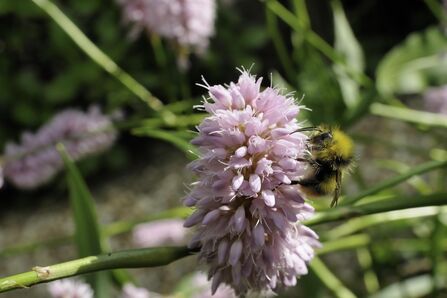
Early bumblebee (Bombus pratorum) feeding on Knotweed flower (Persicaria bistorta "superba") in Wiltshire garden with gravel path in background, UK, May. © Nick Upton/2020VISION
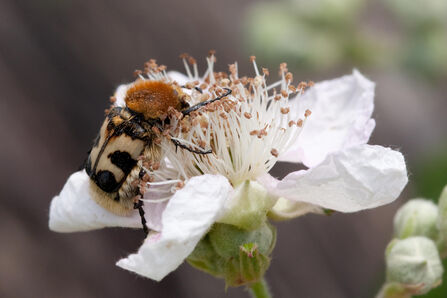
© Vaughn Matthews
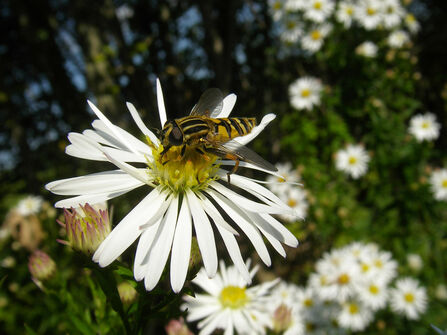
Hoverfly © Vaughn Matthews
Donate to help our grasslands and pollinators
Our current pollinator projects
Planting for pollinators project, funded by Cumberland and Westmorland and Furness Councils from Summer 2023 - present.
The Planting for Pollinators project aims to reverse pollinator decline in Cumbria. This work for pollinators started in summer 2023.
Thanks to funding through the Environment Fund from Westmorland and Furness Council, and Cumberland Council, we're carrying out pollinator friendly works in Barrow, Eden, South Lakeland and Copeland areas of Cumbria.
Get Cumbria Buzzing, Not Buffering brings together Cumbria Wildlife Trust and Fibrus to engage communities where Fibrus has a presence, supporting and encouraging people to take positive action for pollinators in their area.
The project aims to help reverse pollinator decline in Cumbria by creating or restoring flower-rich habitat in 15 community greenspaces by the end of 2025. Cumbria Wildlife Trust will also run community planting sessions and pollinator identification days, and 1,500 packets of native Cumbrian wildflower seeds will be given out to communities across the county.
This project has been made possible through a £150,000 contribution from Fibrus, as part of Hyperfast GB connecting Cumbria.
People and Pollinators Project is funded by Cumberland Council and aims to enrich our green spaces for people and pollinators and builds on our previous award winning work for pollination in Cumbria.
Moss carder bee project Working closely with Natural England, Cumbria Biodiversity Data Centre and local recorders, this project aims to monitor and assess local populations of one of Britain’s rarest bumblebee species, the Moss Carder Bee, Bombus muscorum. Data gathered from this project will be used to inform policy and focus conservation efforts, to provide a network of suitable habitat to enable this enigmatic specialist of flower-rich meadows to thrive. This project is funded by Defra.

In the UK, Defra has identified the primary cause of the decline in wild bees and other pollinating insects as the loss of flower rich habitat2. Indeed, since the 1940’s, we've lost 97% of UK flower rich meadows, 50% of our hedgerows, and 60% of flowering plants are in decline. Available data suggests that these declines are mirrored in Cumbria.
The good news is that it's not too late; few insects have gone extinct so far, populations can rapidly recover3, and by re-instating flower-rich habitats within the landscape, we'll help restore pollinator diversity and abundance. But, we need to act now.
2.’Status and value of pollinators and pollination services’ A report to the Department for Environment, Food, and Rural Affairs (Defra) July 2014 ver. 3 Authors: Dr Adam J. Vanbergen , Dr Matt S. Heard , Dr Tom Breeze , Prof. Simon G. Potts and Prof. Nick Hanley.
3 ‘Insect declines and why they matter’. Professor David Goulson, FULL AFI REPORT WEB1_1.pdf (wildlifetrusts.org)
Our impact


Free resources helping you to support pollinators
Browse below for ideas and inspiration on how you can make a difference for pollinators.
Prof Dave Goulson gave an illustrated online talk for Get Cumbria Buzzing! on how can we can all help to prevent an insect apocalypse. Watch his presentation and discover how we can tackle this crisis, by turning our gardens into oases for wildlife and fundamentally changing the way we grow food.
The importance of pollinators talk by Steven Falk (https://youtu.be/100obiZc5oI)
The importance of pollinators, a talk by Steven Falk
Steven Falk, one of Britain's leading natural historians, discusses the different types of pollinators and what we can do to give them a boost.


Download your free Wild Bee Action pack (pdf) - simple tips to help pollinators.
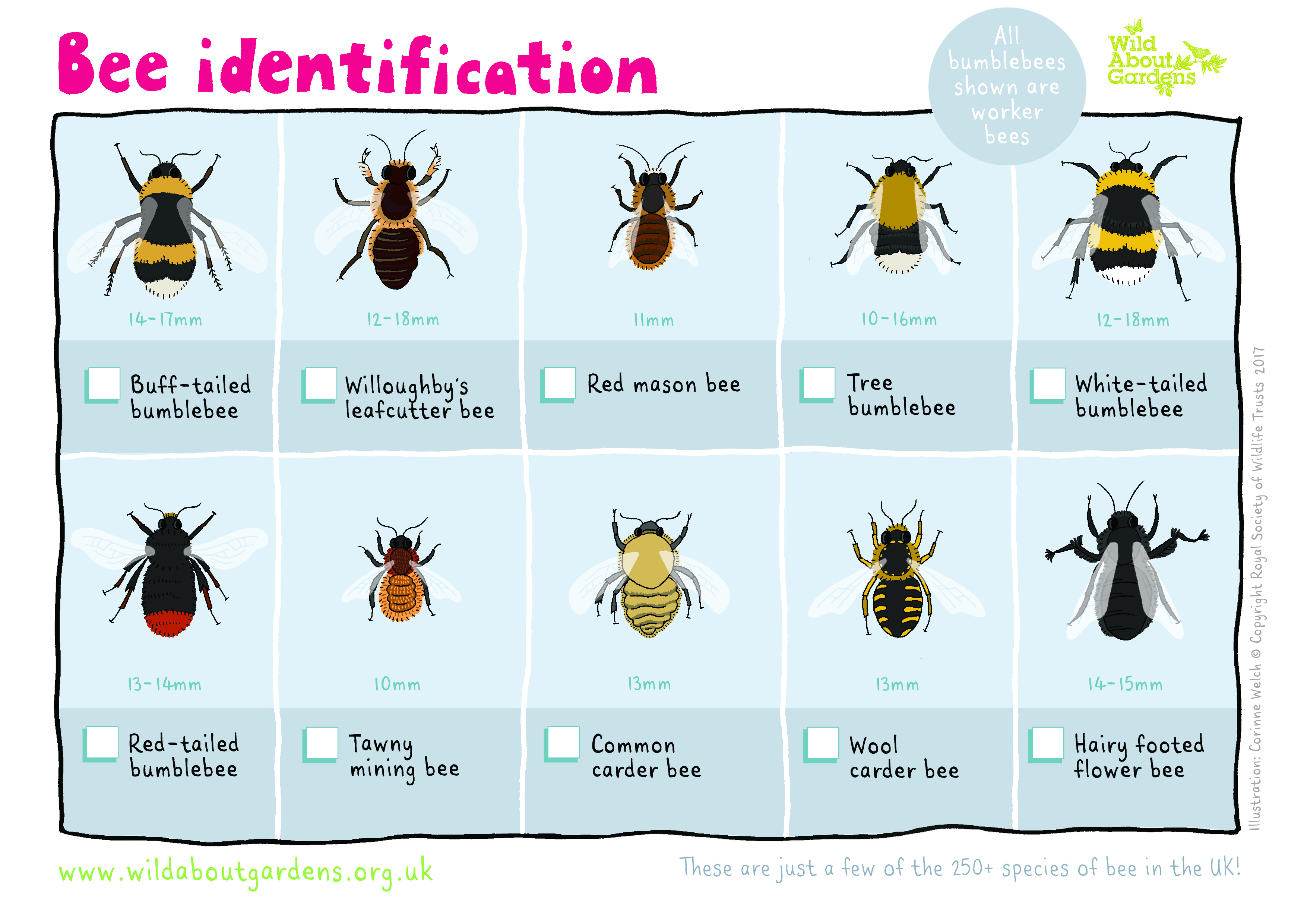
Bumblebee Atlas
During the spring and summer of 2022, Cumbria Wildlife Trust’s Get Cumbria Buzzing! recorded as many Bumblebees and other pollinators as part of its Bumblebee Atlas Project in partnership with the Cumbria Biodiversity Data Centre.
Click the links below for recordings of our webinar series:
- An introduction to identifying and recording butterflies: Common species (via YouTube)
- An introduction to identifying and recording butterflies: Specialist species (via YouTube)
- Pollinator friendly gardening: Planters for pollinators (via YouTube)
- Pollinator friendly gardening: Edible plants to attract pollinators (via YouTube)
- Pollinator friendly gardening: Creating new plants for pollinators (via YouTube)
- The Importance of Pollinators (via YouTube) with Steven Falk
- Get Your Garden Buzzing (via YouTube) - Tips for making your green space pollinator friendly
- The Top 10 Herbs for Pollinator (via YouTube)
- Introduction to moth ID and recording (via YouTube)
- Making hanging baskets that encourage pollinators (via YouTube)
- Herbicides, their effect on pollinators, and what we can do to help (via YouTube)
- The Secret Life of Flies (via YouTube) with Dr Erica McAlister
Click below for more information about National Highways' (formerly Highways England) biodiversity plan, environment strategy and funding:
- National Highway's Environmental Sustainability Strategy (https://nationalhighways.co.uk/our-work/environment/environmental-sustainability-strategy/)
- National Highways' environment fund (https://highwaysengland.co.uk/designated-funds/)
- National Highways' Protecting the Environment PDF (https://highwaysengland.co.uk/media/u20b3kvg/protecting-the-environment.pdf)