
© Cumbria Wildlife Trust
© Cumbria Wildlife Trust
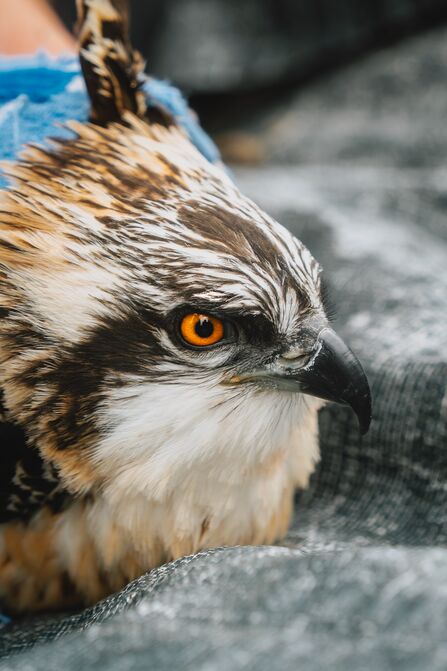
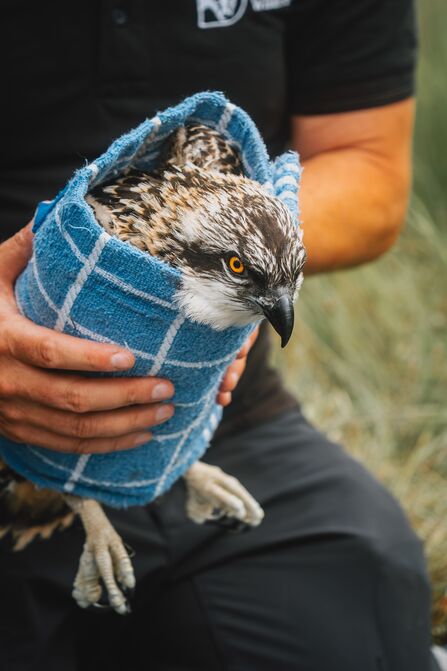
Five osprey chicks at Foulshaw Moss Nature Reserve, four females and one male, were recently tagged and weighed by a licenced and experienced bird ringer, and given a coloured ID leg ring.
This is a record number of osprey chicks to be tagged in one year at our wetland nature reserve near Witherslack. Previously the highest number of osprey chicks in one season at Foulshaw Moss was three.
The increase in numbers is down to the fact that there are now two pairs of breeding ospreys at Foulshaw Moss Nature Reserve. There are two chicks on nest 1 (the long-standing pair Blue 35 and White YW, who started breeding here in 2014) and three chicks on nest 2, which is occupied by the more recent pair, Blue 717 and her mate Blue 476, who first bred here last year.
The male osprey chick (on nest 2) was named as 8K0; the females as 5K4 and 5K5 (both on nest 1), and 8K1 and 8K2 (both on nest 2).
Paul Waterhouse, Reserves Officer at Cumbria Wildlife Trust said: “We’re delighted to have tagged and ringed a record number of osprey chicks at Foulshaw Moss this year. Last year, we had the excitement of a new, younger breeding pair arriving. They only managed to fledge one chick – not uncommon among less-experienced ospreys. It’s wonderful to see this pair return, and with three healthy chicks this year. And we’re so pleased that our long-standing pair, Blue 35 and White YW, are still breeding successfully. We estimate their age to be around 18 years old, so every year they breed feels like a real bonus now!”
The reason for ringing and tagging the birds is so that conservationists can track their movements and understand their life history. In September they'll leave the South Lakeland nature reserve and migrate south to the Iberian Peninsula or West Africa.
Paul explained: “As the osprey is a Schedule 1 protected species, only those with a licence from the British Trust for Ornithology (BTO) are permitted to approach and handle the birds. We keep the process as short and stress-free as possible, with the minimum of handling and time away from normal routine for the birds.”
Osprey chick 2026 © Flynn Murnan
Osprey chick 2026 © Flynn Murnan
Tags for osprey chicks © Flynn Murnan
Blue 35 and White YW first came to Foulshaw Moss Nature Reserve in 2013 after it was transformed by a large-scale habitat restoration programme. Over a decade or so, the 900-acre site, which had been drained and used for commercial forestry, was returned to the healthy wetland you see now, which is teeming with wildlife.
Blue 35 and White YW have bred every year at Foulshaw Moss since 2014. A younger pair, Blue 476 and Blue 717, first arrived at the nature reserve in 2025 and bred in the same year.
The second osprey nest is quite close to the boardwalk and is vulnerable to disturbance, so visitors are asked to be aware of this when they visit. We've built a hide nearby to view the new nest and asks everyone to use this hide respectfully, taking other visitors’ experiences into account.
The car park at Foulshaw Moss Nature Reserve is quite small and gets full quickly. If you’re able to, please access it via public transport – you’ll find information about this on our website. There are also bike racks available.
If you do arrive in a car and find that the car park is full, please return at a later time or date. The access road to the nature reserve is narrow and doesn’t have passing places, so please drive carefully and expect that you may need to reverse to help others pass.
Foulshaw Moss Nature Reserve is open daily, free of charge. It’s located off the A590 near Witherslack.
Use #FoulshawOspreys to join the osprey conversation on social.