A new season of #FoulshawOspreys

A new season of #FoulshawOspreys

© Cumbria Wildlife Trust

Drama, hope, loss, and survival: the 2025 #FoulshawOspreys season was a rollercoaster! We can't wait to see what unfolds this year. Here's the story so far from our osprey volunteer, J Cornell.

Drama returns to the #FoulshawOsprey nests

The first sign of life came on 28 March, when resident male from Nest One, White YW, finally returned – slightly later than last year, but no less welcome. 

Wasting no time, he threw himself into restoring the nest: hauling in sticks and carefully shaping the nest cup. Yet his work wasn’t just practical; there was a sense of anticipation in his behaviour. White YW kept watch, as if expecting a familiar silhouette on the horizon.

That silhouette, however, did not arrive as expected.
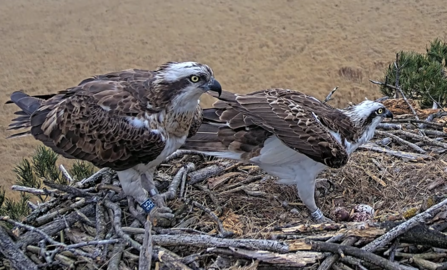
White YW furiously nest building while keeping an eye on the horizon.

© Cumbria Wildlife Trust

Typically, his long-time mate, Blue 35, follows within a couple of days. But this time, three days passed before a female appeared – and it wasn’t her.

Instead, it was Blue 717, neighbouring female from Nest Two. She seemed intent on making herself at home on Nest One, and perhaps with White YW himself.

He, however, was far from convinced.

White YW proved reluctant to accept this unexpected guest. He guarded his fish deliveries closely, mantling over them to keep them from her, and continued his nest-building with a watchful eye still cast outward; waiting, it seemed, for his true partner.

White YW is reluctant to share his catch. Blue 717 tries pecking his tail to get her meal.

© Cumbria Wildlife Trust

But as the days passed without any sign of Blue 35, tensions began to soften. Gradually, the pair settled into a rhythm. Nest building continued, fish were shared, and courtship behaviours – including frequent mating – began to take hold. It appeared that a new partnership might be forming.

And then, just as hope of Blue 35’s return began to fade, everything changed. Early on Easter Monday, 6 April, she arrived.

Wet, bedraggled, but unmistakably determined, Blue 35 wasted no time reclaiming her place. In a swift and decisive encounter, she drove Blue 717 away and re-established her bond with White YW. If ospreys could show emotion, his relief was unmistakable. Within moments, the long-standing pair resumed their partnership as though no time had passed.

See how Blue 35 reclaimed her nest

© Cumbria Wildlife Trust

As for Blue 717, her story did not end in defeat. She returned to Nest Two, where she reunited with her own mate, Blue 476. Together, they began to settle: hesitantly at first with a few false starts until Blue 717 accepted Blue 476 as a worthy mate.

Look at Blue 476 deliver supper, but it's not for Blue 717.

© Cumbria Wildlife Trust

A mystery of instinct and timing

This dramatic start raises some intriguing questions.

Ospreys are known for their loyalty to nesting sites, so why did Blue 717 attempt to take over Nest One? One possibility is timing. Perhaps when she first arrived, her mate, Blue 476, had not yet returned. Faced with an empty nest and a capable male provider in White YW, she may have made a calculated decision driven by instinct and survival.

There were also sightings of another male, Blue 474, on Nest Two around that time adding further complexity to the situation. Whatever the case, once Blue 35 returned on 6 April, Blue 717 stayed firmly at her own nest.

Whose egg is it, anyway?

Eleven days later, both nests saw the arrival of their first eggs – a promising start for the next generation of Foulshaw Ospreys.

But this brings us to another fascinating question.

Given that Blue 717 spent a week with White YW, during which there was frequent mating, before returning to Blue 476, who is the true father of her egg?

The answer lies in a remarkable biological process known as Last Male Sperm Precedence (LMSP).

Ospreys mate frequently, sometimes up to twenty times a day, especially as egg-laying approaches. This behaviour ensures that a male’s sperm is most likely to fertilise the egg. Although sperm can be stored within the female for several days, it does not last indefinitely. Over time, it is either displaced by subsequent matings or naturally lost.

In this case, timing is everything.

An osprey egg is typically fertilised 24 to 48 hours before it is laid. Blue 717 laid her first egg on 17 April, eleven days after her last mating with White YW. In the crucial days leading up to fertilisation, she was with Blue 476.

That makes the conclusion fairly clear: the egg almost certainly belongs to Blue 476.

Adding further weight to this, male ospreys are unlikely to incubate eggs they suspect are not theirs. Blue 476, however, appears fully committed, doing more than his share of incubation duties.

Blue 717 encourages Blue 476 to share egg incubation duties.

© Cumbria Wildlife Trust

Two nests, two stories

As the season unfolds, a contrast is already emerging between the two nests.

On Nest One, the experienced pair, White YW and Blue 35, have slipped back into their roles with quiet confidence.

On Nest Two, the younger pair show a different dynamic. There is more uncertainty, more fidgeting, and the occasional clumsy moment; a reminder that even in the wild, experience matters.

See how the youngsters on Nest Two are sometimes a bit clumsy.

© Cumbria Wildlife Trust

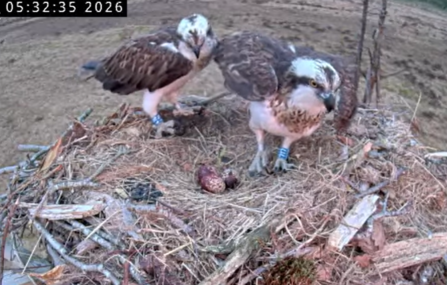
With three eggs on each nest, and awesome webcam views of both Nest One and Nest Two, keep an eye out for their progress and, hopefully, the first hatching any time from 24 May onwards.

Another #FoulshawOsprey season is underway, already rich with drama and intrigue. And if the opening weeks are anything to go by, this year’s story promises to be just as compelling as the last.