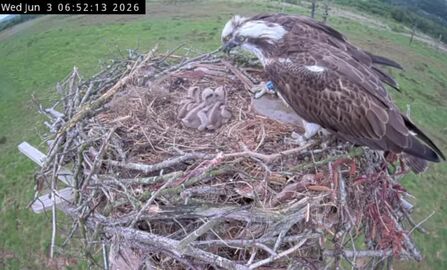
Five new lives. The next chapter for the #FoulshawOspreys

Five new lives. The next chapter for the #FoulshawOspreys

© Cumbria Wildlife Trust  

It's been more than two months since the #FoulshawOspreys returned to their breeding grounds, and what an exciting season it has already been!

We've watched both pairs on Nest One and Nest Two settle back into life at Foulshaw, renew their partnerships, and successfully produce clutches of three eggs each. 

Now, the next chapter begins as a new generation of Foulshaw ospreys emerges...

Egg laying after the ospreys' reunite

When we last left our ospreys in my first #FoulshawOspreys blog of the season, both nests had welcomed their first eggs on 17 April; just eleven days after the females were reunited with their mates.

Two more eggs followed in each nest, at three-day intervals, arriving on 20 April and 23 April.

Careful handling and housekeeping during the long wait for the chicks

The weeks thereafter were filled with the patient routines of parenthood. Both pairs devoted themselves to caring for their precious eggs, carefully turning them between incubation shifts while continuing to bring fresh sticks and nesting material to strengthen and prepare the nests for the chicks to come.

#FoulshawOspreys Just the place for a peaceful supper

Just the place for a peaceful supper

© Cumbria Wildlife Trust  

Osprey incubation typically lasts between 35 and 42 days, and for Blue 35 on Nest One 37 days seems to be something of a favourite.
J Cornell, volunteer at Cumbria Wildlife Trust

Nest one's egg incubation; by the book 

On Nest One, Blue 35 took on most of the incubation duties, spending long hours protecting her eggs while White YW ensured she was well fed with a steady supply of fish from his successful fishing trips. 

Blue 35 patiently kept the eggs warm and protected. She carefully turned them, ensuring they were heated evenly and preventing the delicate membrane surrounding the developing chick from sticking to the inside of the shell.

As hatching time draws near, subtle changes appear in Blue 35's behaviour. She sits slightly higher over the eggs and checks them more frequently, often nudging them with her beak urging the chick inside to take its first steps into the world.

Nest two's egg incubation; a little haphazard

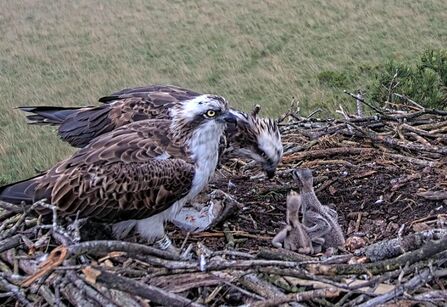
Nest Two presented a rather different picture. The male, Blue 476, proved exceptionally enthusiastic about incubation and was often reluctant to leave the nest. 

More than once, Blue 717 appeared to employ various tactics to persuade him to give up his place and head-off fishing. 

She, meanwhile, busied herself gathering nesting material, although her deliveries occasionally landed rather clumsily among the eggs.

Here, female Blue 717 is on the nest. Blue 476 arrives wanting to take over incubation duties. She reluctantly moves but isn’t too keen to relinquish her role. He is determined to take his turn on the eggs: she isn’t!

The first chick  appears almost bang on time on nest one

Osprey incubation typically lasts between 35 and 42 days, and for Blue 35 on Nest One, 37 days seems to be something of a favourite. Almost like clockwork, her first egg hatched just minutes before reaching the 37-day mark.

For a few days afterwards, all was quiet across Foulshaw. 

A second chick appears on nest two

Then, on 26 May, Nest Two celebrated its first hatching 39 days after the egg had been laid. The excitement immediately shifted to which nest would produce the next chick.

One egg didn't hatch but another one did

Many of us expected another chick to appear on Nest One, but nature had other plans and it wasn't to be. Instead, Nest Two welcomed a second chick on 27 May. As anticipation grew, we wondered whether more hatchlings would follow.

Fortunately, the wait for a chick to emerge wasn't long

On 29 May, a tiny pip appeared on one of the remaining eggs in Nest One. We watched on the osprey cam as the small opening gradually widened into a crack, and then, after a determined struggle lasting just a few hours, a new chick emerged to join its six-day-old sibling at feeding time.

If you look very carefully at this short video you can see a little “pip hole” on the side of the egg where the chick is tapping the shell with its egg tooth. A second later you can see a tiny piece of shell lift as the chick breaks through.

The last arrival but not far behind

At almost the same moment, excitement spread across Foulshaw as movement was spotted in the final egg on Nest Two. 

Not wanting to be outdone, that chick fought its own battle through the shell and, with a little assistance from Blue 717, emerged just an hour after its counterpart on Nest One.

See chick three emerging from its shell as its siblings are fed their breakfast

© Cumbria Wildlife Trust  

Let's do a head count

From six eggs, five healthy chicks hatched; two on Nest One and three on Nest Two.

Why did one of the eggs fail to hatch?

The egg that failed to hatch on Nest One was most likely the second egg laid. While disappointing, it's not uncommon.

A variety of factors can prevent an egg from hatching. 

  • sometimes fertilisation does not occur successfully.
  • in other cases, an embryo may stop developing due to genetic defects.
  • Severe weather, exposure to extreme temperatures
  • accidental damage
  • parental inexperience can also contribute to egg failure.

Nature's back up plan

In many ways, laying three eggs serves as nature's insurance policy. Should one egg fail or one chick not survive, the breeding attempt can still succeed. 

The two chicks on Nest One are already benefiting from having fewer mouths to feed, receiving ample food and growing rapidly. 

You may be wondering: what will happen to the failed egg?

The unhatched egg will remain in the nest and gradually become covered by nesting material over time.

Memorable moments caught on camera

Nest one

Nest One continues to showcase the calm confidence of experienced parents. 

For me, one of the season's highlights has been watching Blue 35 carefully feed both chicks, ensuring the smaller youngster receives its fair share despite the considerable size difference. 

There have already been delightful moments, including seeing the feisty younger chick boldly snatch a piece of fish directly from its larger sibling's beak.

Feisty little chick snatches a morsel of fish from big chick's beak.

© Cumbria Wildlife Trust  

Nest Two

On Nest Two, the highlights have centred around the development of a young family finding its rhythm. 

Blue 717 and Blue 476 have grown into their roles as parents, learning to work together as a team - even if they remain a little clumsy at times. 

Blue 476 has been particularly impressive, taking an active role not only in incubation but also in feeding both his mate and the chicks; something that is relatively unusual and fascinating to watch. 

Another unforgettable moment came before hatching when the faint cheeping of chicks could be heard from inside their eggs.

Blue 476's behaviour is somewhat unusual for an osprey. Typically, the female undertakes most of the incubation and chick-feeding duties, while the male's primary role is to provide food. However, Blue 476 is clearly keen to play a more active part in family life. Not only does he readily take his turn incubating the eggs, but he is also eager to help with feeding. In this clip, you can see him offering food to Blue 717, who then carefully passes it on to the chicks.

More fish to feed the family

With five hungry chicks now in the nests, fish deliveries have increased dramatically.

Both males have brought in some enormous catches, providing enough food to keep the females and chicks satisfied throughout the day.

Encouragingly, the smallest chicks in both nests are thriving. Well-fed and increasingly independent, so far they seem to have avoided the sibling rivalry that can sometimes occur in osprey families.

More than enough fish to go round

© Cumbria Wildlife Trust  

And so the story of the Foulshaw ospreys continues

Five new chicks have entered the world, each with a journey ahead and a personality waiting to emerge. As they grow, develop and take their first steps toward independence, there will undoubtedly be many more memorable moments to share.

The next chapter is only just beginning...

Image of the foulshaw moss breeding pair of ospreys - female on left and male on the right in 2015
Wildlife webcams

Ospreys

Watch osprey family life unfold via our two nest cams and view of the roost tree at Foulshaw Moss Nature Reserve. The birds breed here between March to early September.

Watch osprey cams