Access
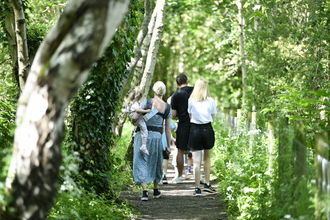
The reserve is accessed directly from a public road. The walk to the highest point on the head and back is 2km/1.2 miles on grass with fairly small gradients. At low tide, it is possible to make this into a circular walk, via Humphrey Head Point and returning via the beach (2.9 km/ 1.8 miles), although this may involve crossing soft sediments in the channel just off the Point.
Directions By car From Grange over Sands take B5277 towards Flookburgh. Just beyond Allithwaite turn left, cross the railway, turn left again and follow road towards the Head. Pass the farm and continue until a track with a public bridleway (part of Cumbria Coastal Way) leads off left. Park here without blocking the track as rescue vehicles require access at all times. The reserve is reached by walking up the drive of the field centre and bearing right. Parking is also possible on the beach at the road end. By bicycle The reserve is 5km/ 3 miles from National Route 72 (Walney to Wear). By public transport Trains run from Barrow in Furness, Ulverston, Grange over Sands and Lancaster to Kents Bank. Buses run from Cartmel and Grange over Sands to Allithwaite and Kents Bank.
Size
23 hectares
Status Site of Special Scientific Interest (SSSI)
Please select a nature reserve from the list below to see more details: Alternatively, you can browse through all the reserves by using this search facility and clicking on one of the links which appear below:
Humphrey Head
What to expect on the nature reserve: habitat, wildlife and more (hover over an icon for more info)
Seasonal highlights on the nature reserve
Spring
Orchids: green-winged
Plants: blue moorgrass
Summer
Plants: spiked speedwell, limestone bedstraw, hoary and common rock rose, wild thyme
Birds: pergerine falcon, ravens
Autumn
Winter
Birds: coastal waders and wildfowl – curlew, redshank and snipe
Humphrey Head is a limestone promontory which is important both for its flora and fauna and for its geological exposures. The nature reserve covers the western cliffs, which have the main botanical interest and the fields on top of the head, but not the woodland. Geographical position, proximity to the sea and the underlying limestone rock give rise to an unusual combination of plants being present.
What to see
On the cliff top which is grazed, plants such as common and hoary rock rose, blue moor-grass, limestone bedstraw, green-winged orchid and wild thyme occur. Further down, out of the reach of sheep, herbs such as bloody cranesbill and spiked speedwell grow. Yew, hazel, Lancastrian whitebeam and ivy are all abundant on the cliffs. Lower still, the salt spray prevents many plants from becoming established but thrift, Portland spurge and rock samphire can tolerate such conditions.
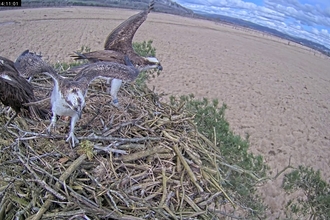
The fields on top of the head have been improved for agriculture in the past but the diversity of the grassland is gradually increasing with annual grazing and no fertiliser application. Small outcrops of limestone pavement and wind sculpted hawthorn trees are features of this area. This is a good place for watching birds on the estuary, particularly when the tide forces them to the shore. Shelduck, curlew and redshank are numerous. Peregrines regularly breed on the nature reserve.
Recent History
Humphrey Head has been leased from Holker Estate since 1992 and was established as a nature reserve in memory of Joy Ketchen, the Trust's first conservation officer.
Find us on
Protecting Wildlife for the Future
Registered in England as Cumbria Wildlife Trust Limited,
a Company Limited by Guarantee No. 724133.
Registered Charity No. 218711.